 |
UV And Indoor Air Polutants | |
| Contact | Login | ||
| profile | uv systems | uv science facts | press releases | uv info | business programs |

Indoor Air Pollution. UV And Air Pollutants
|
 |
 UV facts
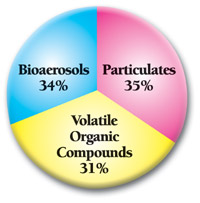
The air in today's buildings can contain different microbial contaminants such as bacteria, viruses, mold, fungi and spores. Bioaerosols are the airborne microbes, their fragments, toxins and waste products. Numerous studies have found high concentrations of such contaminants in the air handling equipment and in the air inside the places where people live and work. These indoor air pollutants can make the air quality less than desirable, may even cause unhealthy effects ranging from allergies to tuberculosis, and are actually the cause of death to an estimated 8.5 million people annually.
According to the EPA "Volatile organic compounds (VOCs) are emitted as
gases from certain solids or liquids. VOCs include a variety of chemicals,
some of which may have short- and long-term adverse health effects.
Concentrations of many VOCs are consistently higher indoors (up to ten times
higher) than outdoors. VOCs are emitted by a wide array of products
numbering in the thousands. Examples include: paints and lacquers, paint
strippers, cleaning supplies, pesticides, building materials and
furnishings..."
UV light itself can not destroy VOC but UV is used as a part of a
process called Photocatalytic Oxidation which can reduce or virtually
eliminate VOCs from the indoor air. In the Photocatalytic Oxidation process
VOC are trapped by a photocatalyst - most often titanium dioxide (TiO2) -
which is activated by high intensity UV light. The harmful VOC are oxidized and turned
into water and carbon dioxide.
Airborne particulates are trapped in the air filters. We recommend a high
quality filter in addition to the UV light. By removing dust and dirt
particles from the indoor air the air filters ensure maximum UV disinfection
efficiency as UV is most effective in pure clean air that is dust free.
Studies show that properly designed and installed UV air cleaners will
help remove or greatly reduce the microbes from the indoor air.
This is why the indoor air quality in public buildings has been addressed by
specific requirements of UV installation inside the HVAC systems.
Residential indoor air quality can also be improved by specially designed ultraviolet fixtures for control of airborne and surface germs inside the AC unit. Germicidal UV can reduce or virtually eliminate all DNA or RNA based microbes that regular filters do not catch.
 Next UV Topic - UV Disinfection of Operating
Rooms During Surgery
Next UV Topic - UV Disinfection of Operating
Rooms During Surgery
© 2002 - 2021
American Air & Water®, Inc.
843-306-0070
Privacy Statement and other Policies
uv disinfection | uv systems | uv science facts | press releases | links and q&a | uv programsuv news | contact