 |
UV Disinfection Process | |
| Contact | Login | ||
| profile | uv systems | uv science facts | press releases | uv info | business programs |

UV Disinfection
|
 |
 UV facts
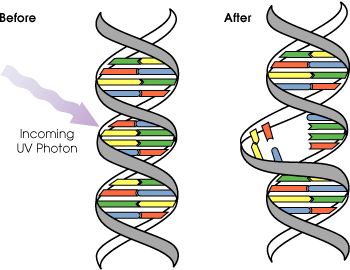
Germicidal ultraviolet (UVC) used for UV disinfection inactivates microorganisms by disrupting their cellular membranes and by damaging their DNA or RNA. The UV light initiates a reaction between two molecules of thymine, one of the bases that make up DNA. UV light at 253.7nm wavelength (germicidal UV or UVC) causes adjacent thymine molecules on DNA to dimerize. The thymine dimer is very stable. If enough of these defects accumulate on a microorganism's DNA its replication is inhibited, resulting in effective UV disinfection by rendering the microorganisms harmless.
 |
|
UV Disinfection Process - Ultraviolet photons harm the DNA molecules of microorganisms. In one common damage event, adjacent bases bond with each
other, instead of across the "ladder". This makes a bulge, and the distorted
DNA molecule does not function properly. |
If a microorganism is introduced to a very high UV dose that leads to the disruption of the its cellular membrane and the death of the cell resulting in effective UV disinfection of the exposed air, water or surface.
The longer the exposure to UVC light, the more thymine dimers are formed in the DNA. If cellular processes are disrupted because of DNA damage, the cell cannot carry out its normal functions and can not reproduce. Microorganisms that can not reproduce can not cause diseases. If the damage is extensive and widespread, the cell will die.
The LIGHT SPECTRUM encompasses radio and infrared waves at wavelengths longer than visible light to the ultraviolet at wavelengths shorter than visible light. Ultraviolet (UV) radiation is electromagnetic radiation of a wavelength shorter than that of the visible region.
Germicidal UV at 253.7nm wavelength, generated by specially designed ultraviolet lamps is used for UV disinfection.
 Next UV Topic - UV Disinfection Dosage for mold,
viruses and bacteria
Next UV Topic - UV Disinfection Dosage for mold,
viruses and bacteria
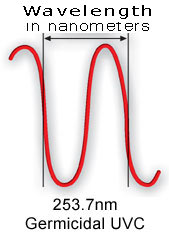
Wavelength is the distance between the crests of two electromagnetic waves.
The wavelength of
germicidal UV is
253.7nm
© 2002 - 2021
American Air & Water®, Inc.
843-306-0070
Privacy Statement and other Policies
uv disinfection | uv systems | uv science facts | press releases | links and q&a | uv programsuv news | contact