 |
UV In The Light Spectrum | |
| Contact | Login | ||
| profile | uv systems | uv science facts | press releases | uv info | business programs |

The Germicidal Nature Of UV Light
|
 |
 UV facts
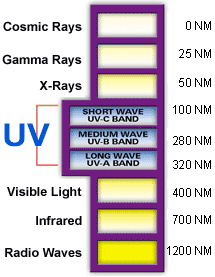
Ultraviolet rays have shorter wavelengths than visible light. A wavelength,
the distance between the crests of two waves, is often measured in units called
nanometers. A nanometer (nm) is a billionth of a meter, or about 1/25,000,000
inch. Wavelengths of visible light range from about 400 to 700 nm. Ultraviolet
wavelengths range from 400nm to about 1nm and are beyond the range of visible
light.
Ultraviolet rays with wavelengths shorter than 300 nm are extremely effective in
killing microorganisms. The most effective sterilizing range for UV is within
the C bandwidth (UVC). This range - between 280nm and 200nm - is called the germicidal bandwidth. UVC has
been used in hospitals for decades to disinfect the indoor air, surfaces and instruments in operating rooms. Many food and drug companies use UV
fixtures with germicidal lamps to
disinfect various types of products and their containers.
UV disinfection is a photochemical process. The microorganisms that
pollute the indoor environment are DNA or RNA based. The cell membranes and DNA break down when exposed to high intensity
UV at 253.7nm. This is the process through which short-wave ultraviolet light can
disinfect liquids, surfaces and indoor air. The
effectiveness of UVC is directly related to intensity and exposure time. Environmental
factors like humidity, airborne mechanical particles and distance can also
affect the performance of the UV fixtures.
The microorganisms must be exposed for a sufficient period of time to germicidal
UV in order for the UV rays to penetrate the
cellular membrane and breakdown the molecular bonds. This bond breakage translates
into cellular membrane damage in which case the cells dye or DNA/RNA damage
which renders the germs harmless because they can no longer reproduce and
cause diseases.

© 2002 - 2021
American Air & Water®, Inc.
843-306-0070
Privacy Statement and other Policies
uv disinfection | uv systems | uv science facts | press releases | links and q&a | uv programsuv news | contact