 |
UV Facts And Test Results | |
| Contact | Login | ||
| profile | uv systems | uv science facts | press releases | uv info | business programs |

Ultraviolet - Research, Results And Facts
|
 |
 UV facts
Ultraviolet light (UV) with wavelength shorter
than 300 nanometers is extremely effective in killing microorganisms. The
most effective sterilizing range of UV is within the C bandwidth (UVC -
253.7nm). This range - between 200nm and 280nm - is called germicidal UV bandwidth or UVC. UVC has
extremely low penetrating ability and does not penetrate past the dead-cell layers of the skin.
UV will cause eye irritations or burns after
prolonged exposure.
 ASHRAE Position Document on Airborne Infectious Diseases
The Application of Ultraviolet Germicidal Irradiation to Control
Transmission of Airborne Disease: Bioterrorism Countermeasure
Ultraviolet Germicidal Irradiation - UVGI - is a common tool in laboratories and health care facilities and is becoming more and more popular with the general public and HVAC engineers. Interest in UVGI is increasing with the growing pandemic concerns and the opportunity to use germicidal UV for reducing energy and maintenance costs. Previous applications of UVGI have focused mainly on control of tuberculosis transmission, but a wide range of airborne respiratory pathogens are susceptible to deactivation by UVGI.
Public Health Reports published an article titled "The Application of
Ultraviolet Germicidal Irradiation to Control Transmission of Airborne
Disease: Bioterrorism Countermeasure". The article is in Volume 118,
Issue Number 2, March/April 2003. In this article, the authors provide an
overview of air disinfection technologies, and an in-depth analysis of
UVGI, its history, applications, and effectiveness.
Read the complete article published here with permission from PHR:
The
Application of Ultraviolet Germicidal Irradiation to Control Transmission
of Airborne Disease
Germicidal UV has been used in water disinfection systems for many years. As stated by the American Water Works Association, "... UV light disinfection process does not use chemicals. Microorganisms, including bacteria, viruses, and algae, are inactivated within seconds of UV light disinfection... Ultraviolet is effective in inactivating Cryptosporidium, while at the same time decreasing chlorinated disinfection by-products... U.S. cities currently using or planning to use UV light water disinfection include Seattle, WA, New York City, Central Lake County, IL, Albany, NY, Tempe, AZ ..."
The UV topics below offer detailed information on the nature of ultraviolet light, science research, facts and conclusions for UV effectiveness. Most importantly, artificially produced UV light by germicidal UV lamps can be utilized to improve the indoor air quality and introduce a healthier environment to live, work or study.
The science behind the UV light
Indoor Air Quality and people's health
Indoor Air Pollution - air pollutants
Ultraviolet Lighting During Orthopedic Surgery
and the Rate of Infection
UV Dosage - Ultraviolet sterilization dosage for mold,
viruses, bacteria, protozoa and yeast
UV Lamps - Artificial UV Production
UV Water Purification Applications
UV Definitions and UV Terminology
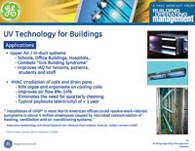
Ultraviolet (UV) Disinfection
The UV light
disinfection process does not use chemicals.
Microorganisms, including bacteria, viruses, and algae, are
inactivated within seconds of UV light disinfection, but all are
not equally sensitive. Generally, viruses and algae are more
resistant to disinfection by UV light.
UV light is effective in inactivating Cryptosporidium,
while at the same time decreasing chlorinated disinfection
by-products.
UV disinfection is used in air and water purification,
sewage treatment, protection of food and beverages, and many other
disinfection and sterilization processes.
One major advantage of UV light disinfection is that it is
capable of disinfecting water faster than chlorine, and without
the need for retention tanks
American Water Works Association - Ultraviolet Disinfection Handbook »
| UV Lamps | |
|
|
 |
© 2002 - 2021
American Air & Water®, Inc.
843-306-0070
Privacy Statement and other Policies
ultraviolet | uv systems | uv facts | press releases | links and q&a | uv programsuv news | contact